Was the Outlook Outage Really Caused by AI? Here's What We Know
Outlook went dark for millions and the internet blamed AI. Microsoft says no. We went through every official statement and the root-cause summary to see what actually broke.
 Microsoft9 min read
For most of Thursday 12 November and into Friday, Outlook simply stopped working for huge numbers of people. Within hours the internet had its suspect: AI. Replies piled up under Microsoft’s posts blaming AI-written code, and people pointed back to CEO Satya Nadella saying last year that software writes a big chunk of Microsoft’s code.
So was it the robots? We read every official statement Microsoft published and the root-cause summary it released on Monday. Here’s what they actually say.
The short answer: no. Microsoft says it was “a technical issue not related to cyber or AI / agents”. Its root-cause summary describes an old-fashioned chain of failures: a months-old software bug, a surge of traffic and missing server capacity. Nothing in it involves AI. One question is still open, which we cover at the end.
What happened
The trouble started on the evening of 12 November, UK time. At 17:54 GMT the official Microsoft 365 Status account posted that it was investigating problems reaching Exchange Online mailboxes, the service behind Outlook email for businesses, “through multiple connection methods in the Americas”.
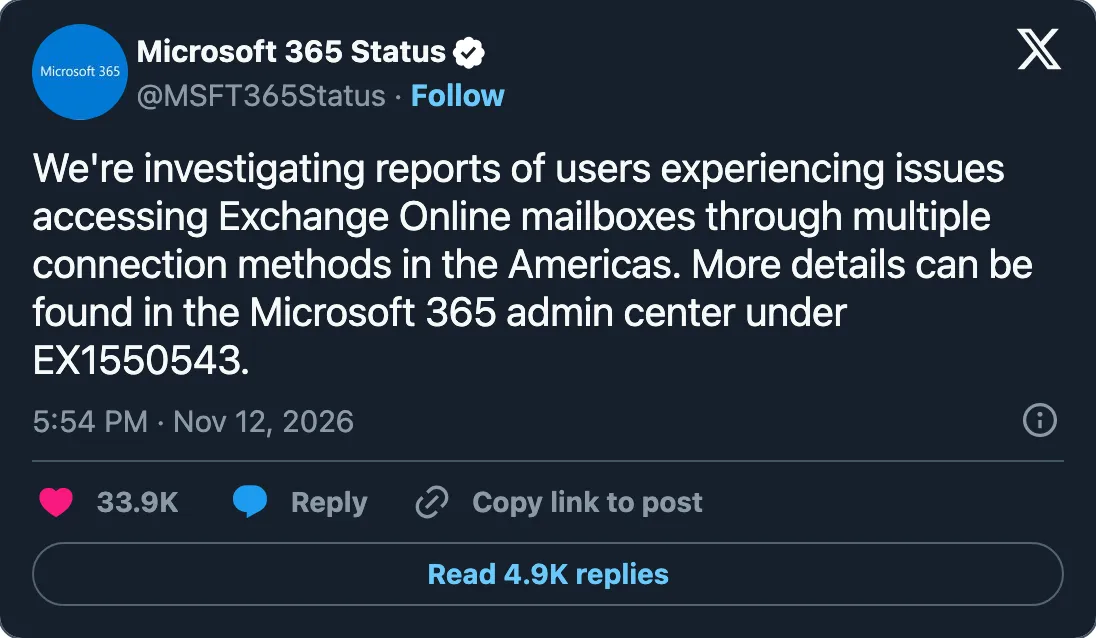
Microsoft’s first public acknowledgement. Source: @MSFT365Status on X.
It was not just the Americas for long. ABC News reported more than 100,000 reports on Downdetector within an hour of that first post. The Register reported that Exchange Online, Teams, Copilot and Defender for Office 365 became unavailable, and that admins couldn’t reach Intune or the Microsoft 365 apps admin center to troubleshoot.
In the UK, according to PA Media, police forces could not take crime reports through their websites and told people to call 101, or 999 in an emergency. NHS England staff fell back on offline measures including paper records, and the National Pharmacy Association warned that NHS email problems could delay some prescriptions. Schools, councils and some National Rail e-tickets sent by email were also affected.
Fixing it was slow. During the night Microsoft’s updates said “a core process on the affected servers is becoming overwhelmed, which causes the servers to stop responding”, and at one point that “our actions taken thus far have not provided the anticipated relief” (as reported by The Register). At 06:09 GMT on Saturday 14 November, about 36 hours after its first post, Microsoft said it had restored service to the remaining affected customers and regions.
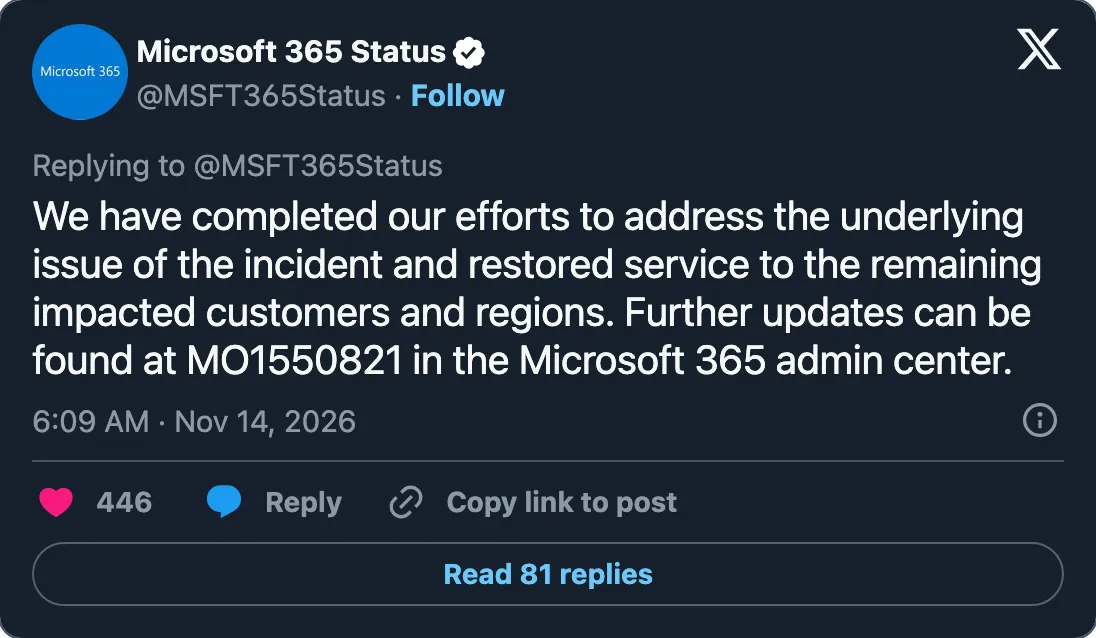
The all-clear. Source: @MSFT365Status on X.
Why people blamed AI
The AI theory didn’t come from nowhere. On the day the outage began, Microsoft Learn’s account on X asked followers which AI habit beginners should build early. According to Windows Latest, the top reply, with more than 4,000 likes, was: “Make sure that your product doesn’t fail.” Other replies told Microsoft to stop pushing unreviewed AI-generated code to production, and some blamed staffing changes at the company.
There was also a quote doing the rounds. Interviewed by Mark Zuckerberg at Meta’s LlamaCon event in April 2025, Nadella estimated that AI writes “maybe 20 to 30 percent of the code that is inside of our repos today”, according to The Register. Put that next to a global email blackout and the theory more or less writes itself.
A theory is not evidence, though. Here is what Microsoft said.
What Microsoft says: “not related to cyber or AI / agents”
On Friday 13 November at 16:40 GMT, the main Microsoft account on X posted an apology and ruled out both a hack and AI.
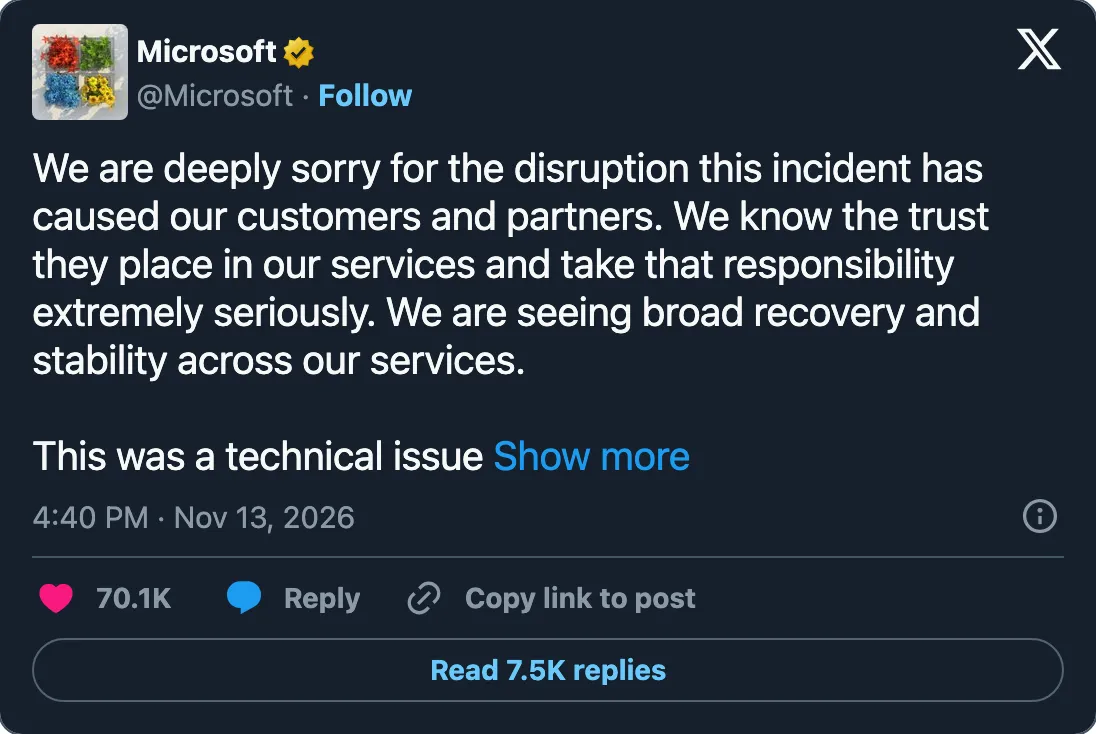
Source: @Microsoft on X. X’s embed cuts the post off at “Show more”; here is the full text:
We are deeply sorry for the disruption this incident has caused our customers and partners. We know the trust they place in our services and take that responsibility extremely seriously. We are seeing broad recovery and stability across our services.
This was a technical issue not related to cyber or AI / agents. The incident was introduced by an issue during an earlier network capacity upgrade that surfaced following a recent network change. We have addressed the underlying issue and continue to restore service to remaining customers and regions.
Given the scale of demand, we restored services gradually, validating stability at each stage. While this took longer, it helped ensure a stable restoration.
We will provide a full post-incident report once our review is complete.
Earlier that day, as KUOW reported, Microsoft had already said there was “no indication this is the result of malicious or cyber activity”.
The root cause, in Microsoft’s own words
On Monday 16 November Microsoft released a preliminary post-incident report to customers in the Microsoft 365 admin center, under incidents MO1550821 and EX1550543. The same morning Charles Lamanna, Microsoft’s executive vice president of Copilot, Agents and Platform, posted an abridged version publicly on X. Yes: the executive in charge of Microsoft’s AI agents is the one explaining that AI agents weren’t to blame.
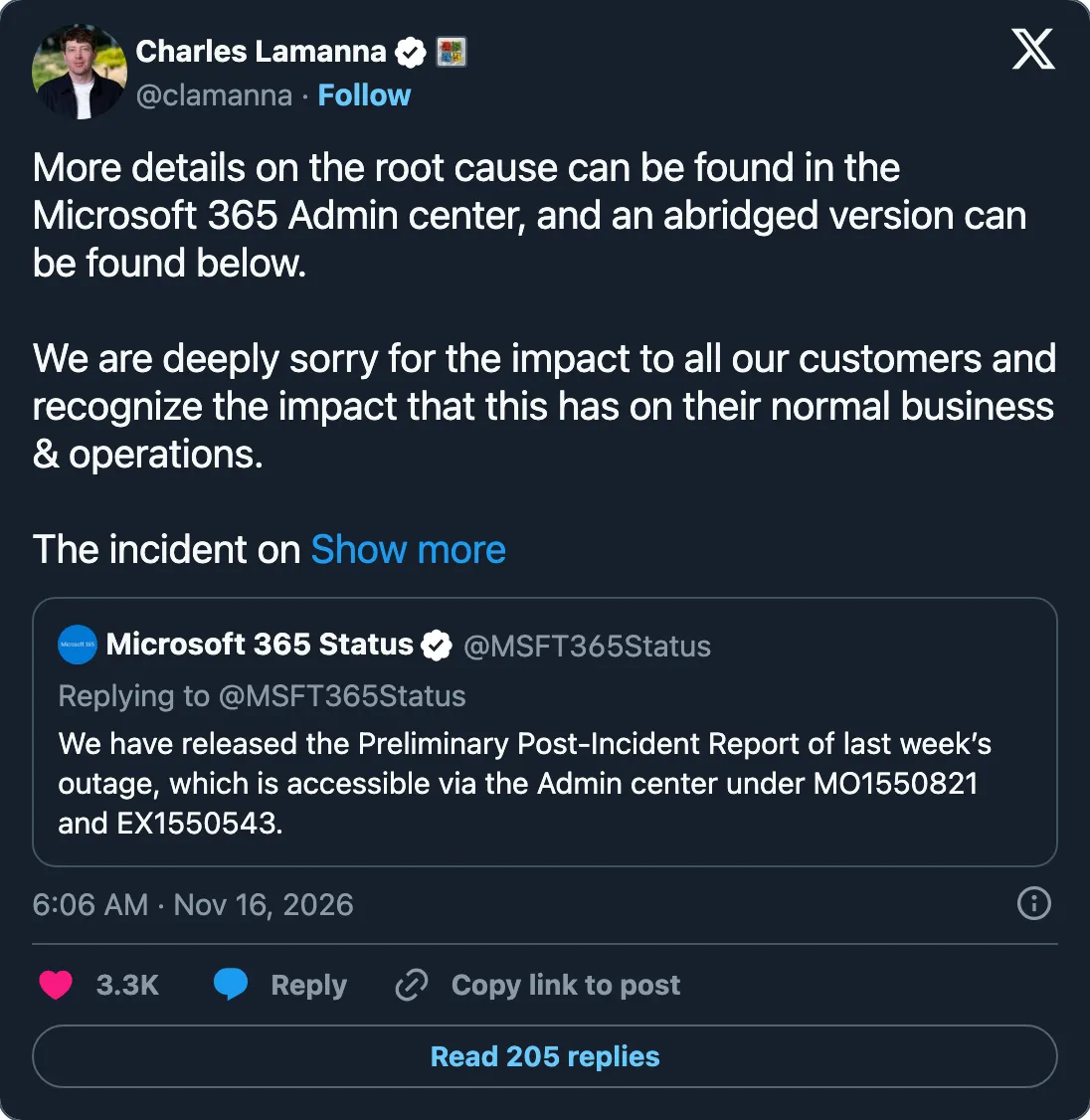
Source: Charles Lamanna on X, quoting @MSFT365Status.
According to the post, the outage hit “the networking gateway that fronts many Microsoft 365 services”, and it was caused by “three main factors” that happened to line up.
1. A bug that had been hiding since July. “A latent defect caused servers to become overwhelmed and unresponsive under certain load conditions,” Lamanna wrote, caused by “lock contention inside an internal process”. In plain English, parts of the software were stuck waiting on each other until the machine stopped responding. The defect came from a fix built specifically for these gateway servers that “first started deployment in July of this year” and ran worldwide “for more than three months” without problems. Testing missed it because the bug is worse on newer machines with more cores, “whereas our load testing tended to focus on our weaker hardware SKUs with fewer cores”.
2. More traffic than usual. About 15 hours before the outage, Teams failed over from Microsoft’s alternative network gateway onto the “primary” one that also serves Exchange Online. That added load and changed the traffic pattern. Microsoft calls this kind of failover “part of normal operations”.
3. Less capacity than usual. At the same time, “nearly 14% of server capacity for the networking gateway was out of service due to an unrelated issue from the previous day”. On its own that would not have mattered.
Together, they set off a domino effect. More load on fewer servers triggered the July bug during the US peak. When servers fell over, Microsoft’s traffic systems did their usual job and sent users to healthy servers, which then overloaded too. “In less than two hours, the previously unknown defect was encountered across our fleet,” Lamanna wrote. “At its lowest, more than 80% of servers were unresponsive.” Because of “a separate issue”, the bulkheads meant to stop a failure in one region spreading to others didn’t hold.
Why it took so long to fix: servers that came back were “immediately overwhelmed by waiting traffic” and fell over again. Because the bug was months old, Microsoft’s usual rollback, flighting and feature-flag tools “were unable to quickly revert the change”. Engineers wrote an update that restored the old code path, then took large groups of servers out of service, patched them and restarted them.
The post also explains why Outlook got the worst of it. Teams, OneDrive, SharePoint and the Office apps could be moved off the faulty gateway, which is why Teams chats and meetings mostly kept working. Exchange Online could not.
So, was it AI?
Our analysis. On everything Microsoft has published, no.
- Microsoft explicitly says the incident was “not related to cyber or AI / agents”.
- The root-cause summary describes a classic distributed-systems failure: a latent bug, a load spike, reduced capacity and a cascade. AI plays no part in it.
- The “automated” systems in the story are ordinary traffic management and recovery tooling, not AI agents. If anything, the automation made things worse by routing load onto servers that then failed too, which is a well-known way for outages like this to spread.
- We found no official statement, filing or credible report linking the outage to AI-generated code or to staffing changes.
What we still don’t know. Microsoft’s statements don’t say who wrote or reviewed the July fix, or what tools they used. Nothing published suggests AI was involved, but the summary doesn’t cover how the code was written either way. Microsoft also hasn’t explained the “separate issue” that let the failure cross regions. Lamanna said the final post-incident review would add detail “later this week”, so we will update this article if it changes the picture.
The real lesson is less dramatic than “AI broke email”. A bug that only shows up on the biggest servers under the heaviest load sat unnoticed for three months, until a bad day lined everything up. That can happen to any large system, whoever writes the code.
Sources
- Microsoft 365 Status on X: first acknowledgement, 12 November 2026
- Microsoft on X: apology and “not related to cyber or AI / agents” statement, 13 November 2026
- Microsoft 365 Status on X: service restored, 14 November 2026
- Microsoft 365 Status on X: preliminary post-incident report released, 16 November 2026
- Charles Lamanna on X: abridged root cause, 16 November 2026
- Microsoft 365 service health status page
- The Register: Microsoft struggling to fix massive cloud outage that’s taken down email and Intune (12 November 2026)
- ABC News: Outlook outage updates: Microsoft apologizes for email disruption, says there was no hack (13 November 2026)
- PA Media via The Irish News: Microsoft ‘deeply sorry’ for disruption caused by major global outage (13 November 2026)
- KUOW: As Microsoft services return online, company says outage wasn’t caused by AI or cyberattack (13 November 2026)
- CNBC: Microsoft apologizes for massive outage that took down Outlook and other 365 services (12 November 2026, updated 14 November)
- Windows Latest: Microsoft asked for AI tips on the day a Microsoft 365 outage hit millions (13 November 2026)
- The Register: 30 percent of some Microsoft code now written by AI - especially the new stuff (30 April 2025)