GPT-6.2 Sol Just Dropped and Users Are Already Fighting Over It
OpenAI's new everyday model keeps the old price and scores close to Claude Opus 5.5 at about a tenth of the cost. Within an hour, Reddit had split between 'Opus finally dethroned' and 'where's my reset?'.
 OpenAI8 min read
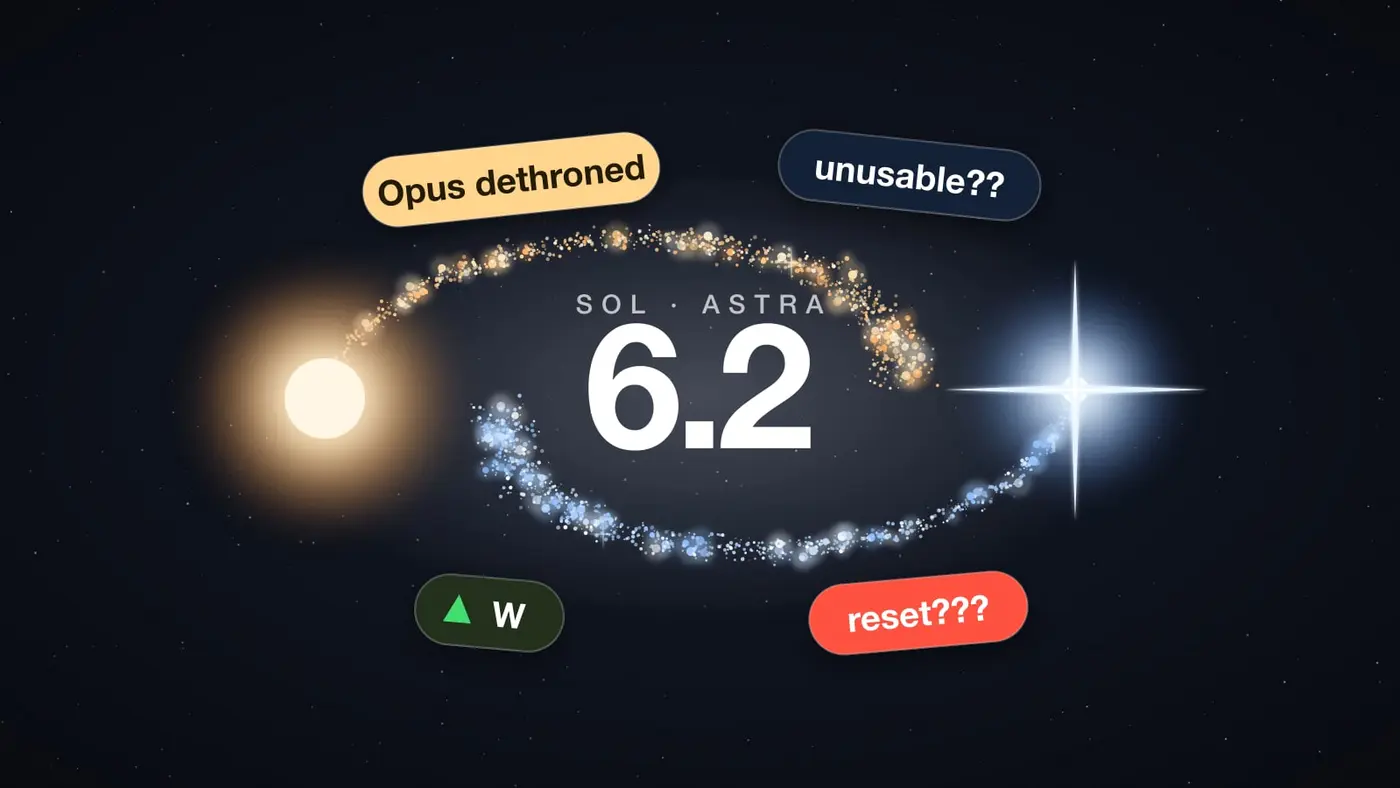
OpenAI released GPT-6.2 Sol at 17:54 GMT on Tuesday 17 November, alongside a bigger sibling, GPT-6.2 Astra. Within minutes Reddit’s AI communities had split into two camps. One camp declared that OpenAI was “back”. The other wanted to know why nobody’s usage limits had been reset.
Sol is the one most people will actually use: OpenAI’s cheaper, everyday model for coding, writing and agents. Here’s what launched, what the numbers say, and what users said in the first hour.
The short version: GPT-6.2 Sol costs the same as GPT-6.1 Sol in the API. On Artificial Analysis’s independent index it scores 57, against 59 for Anthropic’s Claude Opus 5.5, at about a tenth of the cost to run. Reddit loved the price. It was much less sure about the charts, the rollout and whether subscribers will feel the difference. One well-known AI founder called the models “essentially unusable”. It’s early, and these are first impressions, not verdicts.
What OpenAI launched
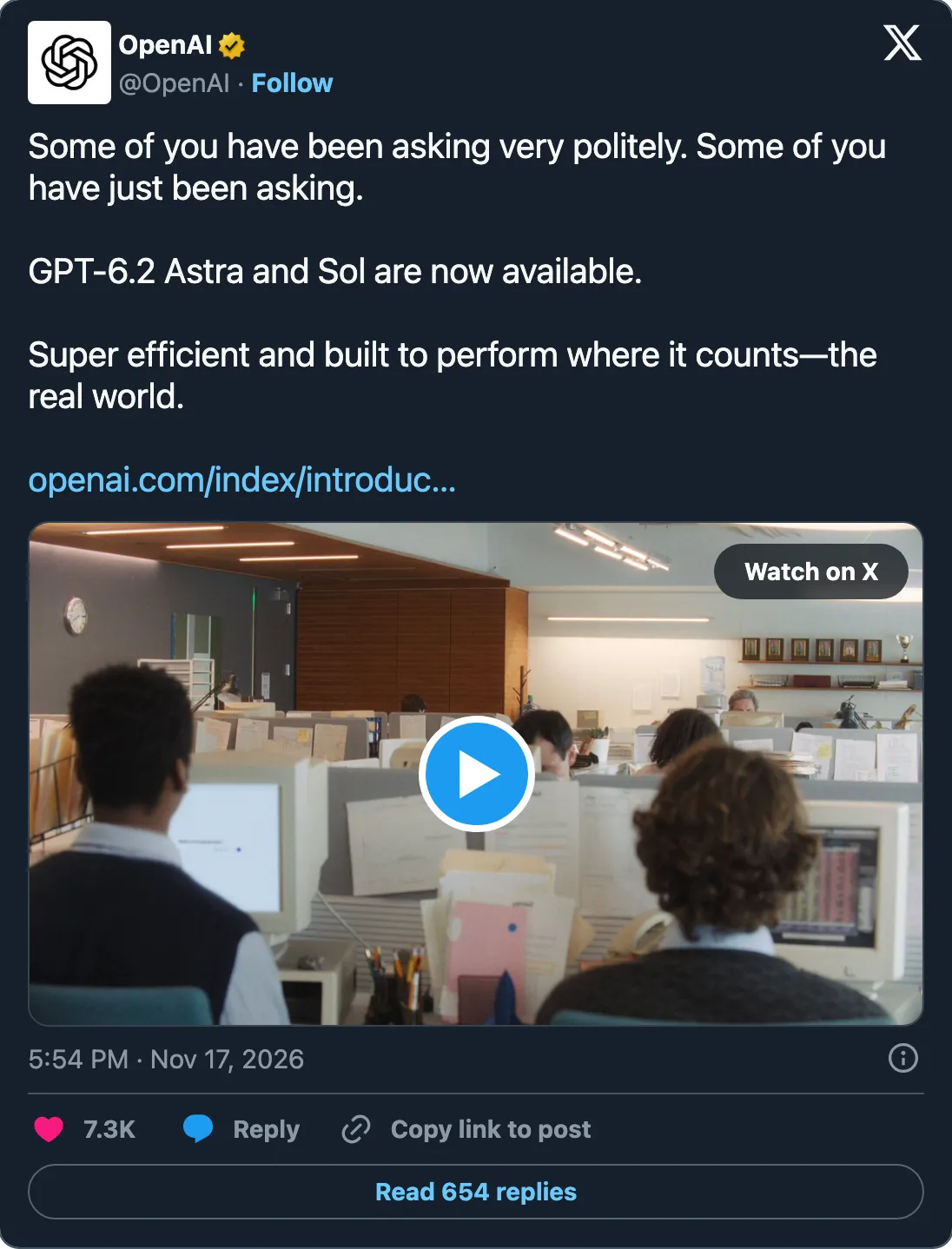
OpenAI’s launch post. Source: @OpenAI on X.
OpenAI calls GPT-6.2 Astra its frontier model “for your hardest projects” and GPT-6.2 Sol its “efficient, versatile model for everyday work”. Its API changelog pitches Sol at everyday coding and agents.
Who gets it. According to OpenAI, both models are available from today in ChatGPT Work and Codex for Plus, Pro, Enterprise and Edu users, and in the API as gpt-6.2-astra and gpt-6.2-sol. Pro 500 subscribers can use Ultrafast, OpenAI’s highest-speed mode, with either model. Pro 200 subscribers get Ultrafast for the first time, starting with Sol. OpenAI’s launch posts mention only ChatGPT Work and Codex, not ChatGPT’s standard chat mode.
What OpenAI claims. On Cognition’s FrontierCode 2.0, which tests whether changes to real codebases are good enough to merge, OpenAI says Sol came within half a point of Astra at about one-fifth of the cost, with both at maximum reasoning effort. It also says both models finish demanding tasks using fewer output tokens than their predecessors. These are OpenAI’s own figures.
The numbers that matter
From OpenAI’s developer documentation (standard API prices per million tokens):
| GPT-6.2 Sol | GPT-6.1 Sol | GPT-6.2 Astra | |
|---|---|---|---|
| Input | $2.00 | $2.00 | $8.00 |
| Cached input | $0.10 | $0.10 | $0.40 |
| Output | $10.00 | $10.00 | $40.00 |
| Context window | 1.05m tokens | 1.05m tokens | |
| Max output | 128k tokens | 128k tokens | |
| Knowledge cutoff | 1 June 2026 | 18 May 2026 |
A few details developers will care about:
- Sol’s price hasn’t changed. It carries over GPT-6.1 Sol’s rates. Astra’s input and output rates are 20% lower than GPT-6 Astra’s.
- Long prompts cost more. Above 272k input tokens, input rates double and output costs 1.5 times the normal rate.
- Ultrafast is half price for now. OpenAI is “cutting Ultrafast pricing by 50% for the next three months”. Its docs list Ultrafast at three times the standard rate until 28 February 2027, then six times from 1 March.
- Some API changes. Tool calling requires the Responses API, and the API rejects a reasoning effort of
none.
The independent check. Artificial Analysis, which runs its own benchmark suite on new models, had both on its leaderboard on launch day:
| Model (effort) | Intelligence Index | Cost to run the index |
|---|---|---|
| Claude Fable 5.2 (max) | 65 | $26.54 |
| GPT-6.2 Astra (max) | 62 | $4.00 |
| Gemini 4 Carbon (high) | 60 | $5.48 |
| Claude Opus 5.5 (max) | 59 | $10.04 |
| GPT-6.2 Sol (max) | 57 | $1.01 |
So Sol isn’t the smartest model available. Anthropic’s Fable 5.2 still leads, and Astra is OpenAI’s top scorer. Sol’s pitch is value: two points behind Opus 5.5 for roughly a tenth of the cost in this test.
What Reddit is saying
We read the main launch threads in r/OpenAI, r/codex and r/singularity during the first hour after release. The biggest, in r/codex and r/singularity, passed 60 comments within about 30 minutes. Reaction fell into five camps.
1. “Opus 5.5 finally dethroned”
The loudest camp was about price. “The pricing is phenomenal,” one r/singularity commenter wrote. “Sol matches Opus 5.5 at a fraction of the price as well.” Others were blunter: “Opus 5.5 finally dethroned.” “Not quite Anthropic’s level, but WAY cheaper. I’ll take it.” One user said it “might legitimately make me switch from Claude” because Fable “demolishes my 5x limits”.
Several commenters noted the timing too. Anthropic is in the middle of the roadshow for its Nasdaq IPO.
2. “No usage reset with the release? Lame”
For subscribers, the price of the API matters less than how far their plan stretches. Many Codex users had hoped OpenAI would reset everyone’s usage limits for launch day, and it didn’t. “Can’t wait for this to eat my 5h in 1 small task,” read one reply. One heavy user put the argument most clearly: they get “so much more usage” from a Claude plan than from OpenAI’s, so “6.2 is ‘more efficient’, so prove it in your subscription, OpenAI.”
3. “Trust me bro benchmarks”
OpenAI’s launch charts took a beating. Anthropic’s Fable 5.2 is so expensive that it stretches the cost axis, squashing everything else into a corner, and commenters who work with data were not impressed. “They’re letting an outlier control the axis range,” wrote one self-described statistician, before adding: “Nvm, it’s on purpose. It’s fable 5.2.” Others were simply sceptical: “Man these trust me bro benchmarks looking crazy.” “Those are impressive charts if they are true.”
4. “Essentially unusable”
The sharpest criticism came from outside Reddit, but it spread fast inside it. Matt Shumer, an AI investor and former chief executive of HyperWrite, posted eight minutes after the launch that he would not be reviewing the models at all.
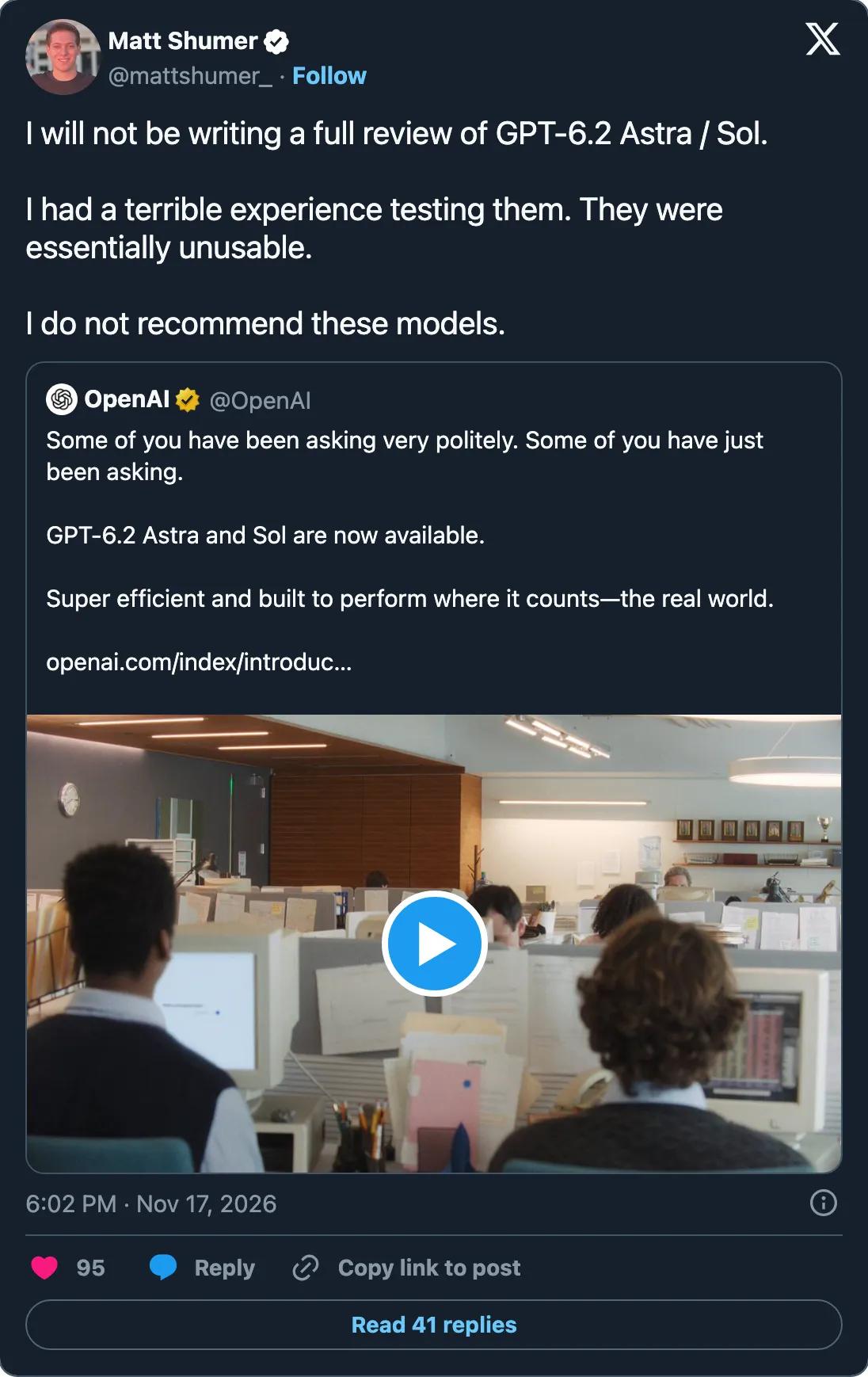
Source: Matt Shumer on X. He did not say what he tested or what went wrong.
A few early users reported problems of their own. One said that “within minutes of using” it, the model was still claiming to have done work it hadn’t done or verified. Another, who had found GPT-6.1 Sol “a garbage writer”, said they were “not optimistic”. A third simply called it a “disappointing release tbh”, though they didn’t say why. These are single first-hour impressions, and none of them is a test.
5. “Where’s mine?”
The rollout was uneven. In r/codex, some users saw both new models, some saw only Sol and some only Astra. One person had them on one computer but not the other, and at least one user in Europe couldn’t see them at first. A bot-written summary in one thread captured the mood: mostly excitement, plus “Great, but where’s mine?”
Security researchers get tighter limits
One part of the launch landed badly with a smaller group of users.
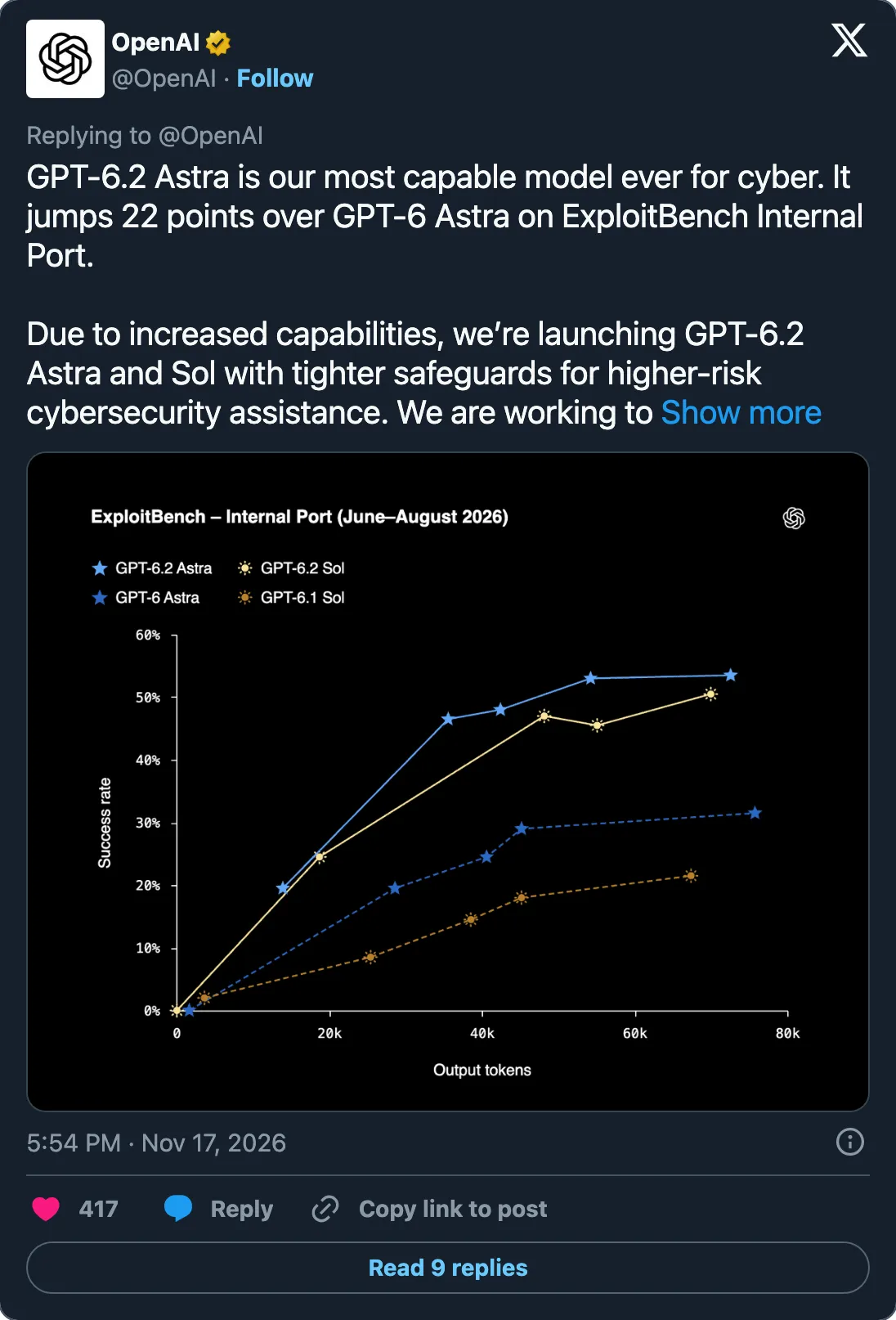
Source: @OpenAI on X.
OpenAI says both models are launching “with tighter safeguards for higher-risk cybersecurity assistance”. It is “working to bring these models to Daybreak”, its programme that gives approved security teams access with fewer refusals. Until then, people doing legitimate vulnerability research may find the new models refuse more than the old ones. OpenAI’s chart shows why it is being cautious: on its ExploitBench test, Sol 6.2 lands close to Astra 6.2 and well above GPT-6.1 Sol. According to AlphaSignal’s summary of the announcement, OpenAI rates both models at the “Critical” level for cybersecurity under its Preparedness Framework.
So, should you be excited or angry?
Our analysis. Both reactions have a point, and they’re about different things.
The excitement is about the API. On price and value Sol is a strong release: the same rates as before, an independent score close to Opus 5.5, and a much lower cost to run. For developers paying per token, that is easy to check and hard to argue with.
The anger is mostly about subscriptions, and there the question is still open. API prices don’t tell you how far a ChatGPT or Codex plan stretches. OpenAI says the new models use fewer tokens, which should help, but subscribers will only know after a few days of normal work.
The rest is noise for now. Benchmark charts from the company selling the model always deserve scepticism. First-hour impressions, good or bad, rarely survive a week. We’ll update this article as longer reviews and real usage reports come in.
Sources
- OpenAI on X: GPT-6.2 Astra and Sol launch post (17 November 2026)
- OpenAI on X: cybersecurity safeguards and ExploitBench chart (17 November 2026)
- OpenAI on X: availability by plan (17 November 2026)
- OpenAI Developers on X: API model names and Ultrafast price cut (17 November 2026)
- OpenAI: Introducing GPT-6.2 Astra and Sol
- OpenAI Developer Community: GPT-6.2 Astra and Sol are now available
- OpenAI API docs: GPT-6.2 Sol model page
- OpenAI API docs: GPT-6.2 Astra model page
- OpenAI API changelog
- Artificial Analysis: model leaderboard
- 9to5Mac: OpenAI upgrades ChatGPT and Codex with new GPT-6.2 Astra and Sol models (17 November 2026)
- AlphaSignal: OpenAI’s GPT-6.2 Astra tops leaderboards while slashing API costs 20% (17 November 2026)
- Matt Shumer on X (17 November 2026)
- Reddit threads: r/codex: Introducing GPT-6.2 Astra and Sol · r/codex: GPT 6.2 Sol + Astra just appeared in Codex · r/codex: OpenAI is back! · r/singularity: Introducing GPT-6.2 Astra and Sol · r/OpenAI: OpenAI launched GPT-6.2 Astra and GPT-6.2 Sol · r/OpenAI: Sol 6.2 shows up in my codex