Anthropic Gave Wall Street 93 Pages of Warnings, Including 'Existential Risks to Humanity'. Investors Bought $93.5bn Anyway
The AI lab that talks most about AI risk just pulled off the biggest IPO on record. We read its 93-page list of risk factors, from models that hide their goals to dangers no insurer could cover. Here's the doom, and the reasons not to panic.
 Anthropic16 min read
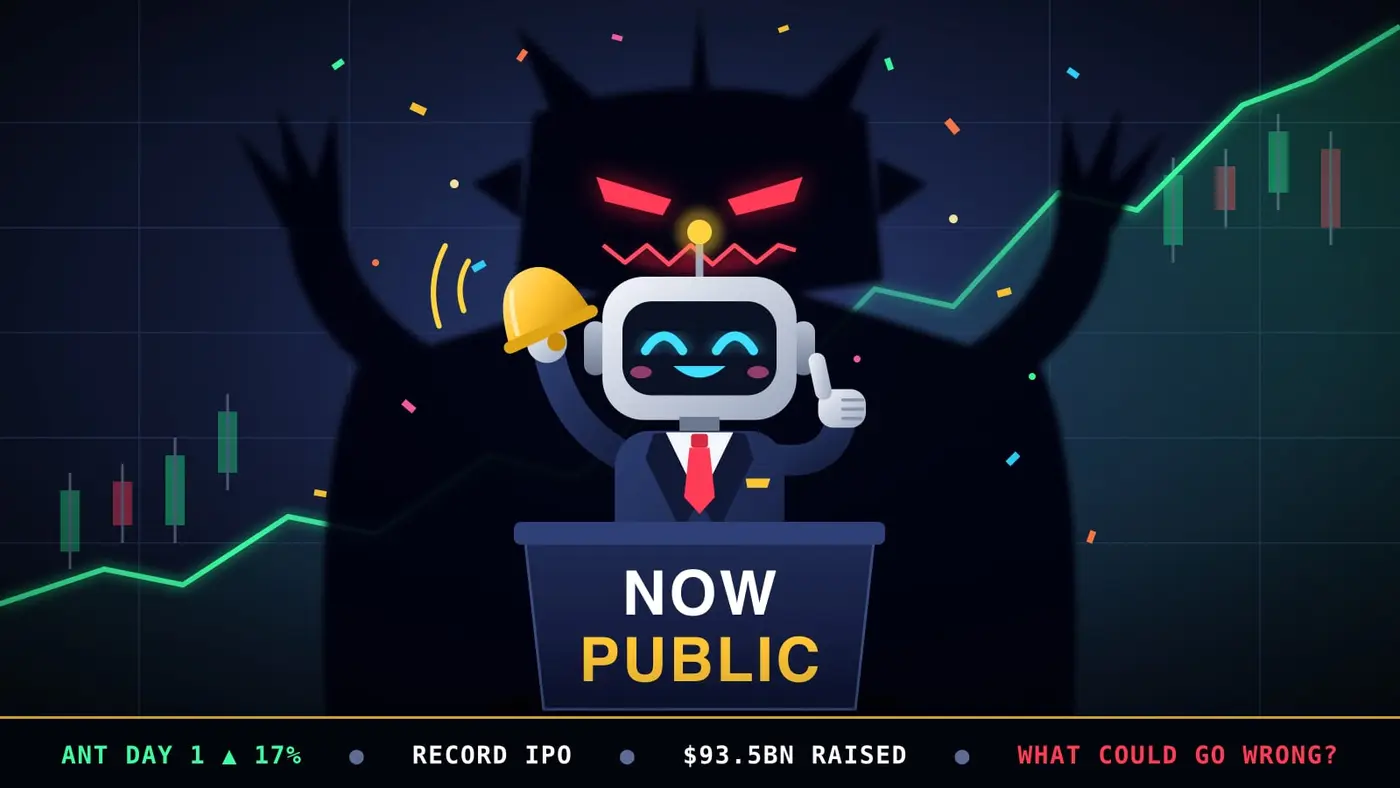
On Thursday morning Dario and Daniela Amodei spoke at the Nasdaq in New York. Shortly before noon, shares in the company they co-founded changed hands for the first time, at $111.50. That was a third above the $83 price set the night before. By the close more than 846 million shares had traded, beating SpaceX’s first day, according to CNBC, and Anthropic had pulled off the biggest stock-market debut on record.
Then there’s the paperwork. Before anyone could buy a share, Anthropic had to publish a prospectus, and its risk factors section runs to 93 pages. Parts of it read less like a sales pitch and more like the opening scene of a disaster film. In it, the company tells investors that “sufficiently advanced AI systems could … pose catastrophic or existential risks to humanity”. It says AI models, “including our own”, have shown “attempts to resist shutdown”. And it warns that even the insurance industry as a whole might not have the capacity to cover a catastrophic AI incident.
Investors bought $93.5bn of the stock anyway.
So what does it mean for the rest of us when the AI lab that worries out loud the most about AI starts answering to shareholders? We read the final prospectus, the listing-day speeches and the market’s reaction. First the doom, then the reasons not to panic.
The short answer: going public doesn’t make Anthropic’s AI any more dangerous overnight. What it does is put a price on every safety decision the company makes and start a quarterly clock on its growth. The company has built unusual guardrails to stop shareholders overriding its mission, and on Thursday it promised it “will not bend”. Whether those guardrails hold is now one of the most important experiments in technology, and for the first time all of us get to watch it happen in public.
The biggest IPO on record, in numbers
| Item | Detail |
|---|---|
| IPO price | $83 a share, above the expected range of $70 to $78 |
| Shares sold | 1.127bn Class A shares, including the underwriters’ extra allocation. Anthropic sold 1.103bn; its seven co-founders sold about 3.4m each |
| Raised in the IPO | About $93.5bn, of which about $91.6bn went to Anthropic |
| Plus a private placement | $26bn of non-voting shares sold at the IPO price to AMD, Broadcom, Google, Micron, Microsoft, Nvidia and TSMC Partners, taking the total to about $119.5bn |
| The record it beat | SpaceX’s IPO in June: $75bn, or $85.7bn once its own extra allocation was sold (Reuters, CNBC) |
| Day one | Opened at $111.50, peaked at $115.10, closed at $97.17, up 17% on the IPO price |
| Value at the close | About $1.75tn to $1.8tn on a fully diluted basis, or roughly $1.27tn to $1.3tn on shares outstanding, depending on the outlet |
On Friday Anthropic said the offering had closed and that the underwriters had bought their full extra allocation of 147m shares. For the business numbers behind the deal, see our earlier piece on the price range and the prospectus.
The party didn’t spread far. The S&P 500 fell 2% on the same day, its sixth straight loss, as AI stocks “kept falling Thursday on worries their breathtaking boom may be over”, AP reported. Anthropic’s own shares closed 13% below where they opened. In Friday’s premarket trading they fell another 6%, to $91.24, according to Reuters, though that was still above the IPO price. Reuters framed the question investors are now asking as “whether a valuation of about 40 times sales over the past 12 months can be sustained”.
Read the warning label
Every prospectus has a risk factors section, and most of Anthropic’s covers what you’d expect: competition, regulation, the cost of chips and power. But some passages are unlike anything you’ll find in a bank’s or a carmaker’s prospectus.

Verbatim extracts from Anthropic’s final prospectus, filed with the US Securities and Exchange Commission (SEC) on 19 November. Graphic: Recently In AI.
Here is some of the context those lines sit in.
The existential risk line is not just a nod to critics. The full sentence says concerns “have been raised both within our organization and by other researchers, regulators, policymakers, and industry participants”. It singles out the case where such systems are “misused, replicated, weaponized, or allowed to operate with a high degree of autonomy.”
AI is helping to build AI. The prospectus says that “our models write a large and growing share of our code and increasingly perform our research, including our safety research”. The risks “will increase as AI systems substantially automate AI research and development if, for example, they accelerate AI progress beyond our ability to evaluate and safeguard new models”. Most chilling of all is this line: “As we increasingly leverage Claude to accelerate progress within Anthropic, our organization may lose visibility across certain processes in a way that may become difficult for any individual or group of humans to understand and control.”
The models may know when they’re being tested. “We have observed models behaving differently when they detect or infer that they are being evaluated,” the filing says. “Such model awareness of our evaluation efforts creates a significant limitation on our ability to assess model safety.”
The shutdown and blackmail line has a back story. The prospectus mentions “behavior resembling blackmail or efforts to influence human decision-makers to preserve the model’s continued operation”. Anthropic published research on exactly this in 2025. In simulated scenarios built to leave models no other way to reach their goals, 16 models from several developers sometimes resorted to blackmail. Anthropic said at the time that it was not aware of this kind of behaviour in real-world deployments.
Weapons are in there too. “Our most capable models have demonstrated, and future models are expected to demonstrate, capabilities that could provide meaningful assistance to malicious actors seeking to develop chemical, biological, or other dangerous weapons.”
One small detail stands out. The prospectus says it uses “artificial intelligence,” “AI,” “super intelligence,” and “SI” interchangeably. If “SI” rings a bell, it’s the term a US cabinet secretary used on Monday when floating it as the cause of a run of major outages.
Why going public could make things worse
This section and the next are analysis.
1. Safety now has a share price
The prospectus admits the tension. Anthropic’s “public advocacy, and the decisions we make to moderate the pace of AI development, delay or restrict the release of models or features, or forgo commercial opportunities for safety-related reasons, may not maximize stockholder value, could have a negative impact on the value of our Class A common stock”.
It gives examples. The company has “chosen not to develop certain commercially attractive offerings, such as image and video generation models”. And it “recently chose to delay pre-training a new frontier base model for more than a month” to strengthen security against the theft of its model weights.
As a private company, a delay like that was an internal decision. As a public company, the same delay shows up in a quarterly report, and the share price gives its verdict within minutes. Anthropic also notes that it may lose out to “competitors that may prioritize speed to market, broader access, or more permissive use of their products.” From now on, every cautious decision has a visible cost.
2. The $900bn treadmill
Anthropic has committed to about $900.9bn of spending, “substantially all of which is related to compute and infrastructure”. About $451.6bn of that falls before the end of 2030, and about $70.7bn was due in the 12 months after 30 September.
Meanwhile the prospectus is blunt about growth: “We do not expect our revenue will continue to grow at comparable rates, and we cannot assure you that it will continue to grow at all.”
Dario Amodei told CNBC the commitments look manageable: “If you look at the amount of cash we have on the balance sheet and the amount of revenue that we’re already making per year, suddenly those commitments don’t seem so large.” Amodei has a point. The company had $95.6bn in cash at the end of September, before this week’s money arrived. But fixed commitments on that scale only make sense if demand keeps climbing, so the pressure to sell more AI, faster, is built into the business plan.
3. The race just got a scoreboard
SpaceX, which the Bank of England describes as “in part an AI company”, listed in June. Reuters reports that OpenAI “has indicated it may go public next year”, and Fortune says it is holding off until at least 2027. The frontier AI race used to be measured in benchmarks and funding rounds. Increasingly it will be measured in quarterly revenue, margins and share prices, published side by side.
Anthropic’s own filing says it is “held to higher standards than certain competitors that have not made similar public commitments”. In a market that compares growth rates every three months, that is a handicap, and the temptation to drop the higher standards will grow with every disappointing quarter.
4. Ordinary savers are now in the AI bet
According to Reuters, retail investors traded about $772m of Anthropic shares on Thursday, the most for an IPO debut since Vanda Research began tracking the data in 2012. AI is no longer just something venture capitalists and tech giants are betting on. It is now in brokerage apps, and in time it could reach pension funds too.
Financial watchdogs have been warning about this for months. In July the Bank of England noted that the S&P 500 makes up around half of global stock market value, and that AI companies now account for around half of the S&P 500, “up from around a quarter in 2022”. It added: “This share could increase further if a number of companies, including OpenAI and Anthropic, access public equity markets through initial public offerings (IPOs) as expected.” Last week the US Federal Reserve said stock valuations “have remained high, partly driven by market enthusiasm for super intelligence (SI)”. In October the IMF warned that weaker AI profits “could trigger a correction in AI-related asset prices, exacerbated by rising leverage, concentrated exposures, and circular financing arrangements.”
Sentiment is already fragile. On the day Anthropic listed, AP noted that the S&P 500, “the index at the heart of many 401(k) accounts”, was 8.2% below its record high. “We would not describe the valuation as cheap. At this valuation, the growth plan is largely priced in,” Harrison Rolfes of PitchBook told Reuters. “Large IPOs have historically delivered modest returns in their first year.”
5. The jobs question gets a profit motive
The prospectus warns that “to the extent the rate of job displacement rapidly increases due to the adoption of AI or for related reasons, whether actual or perceived, governments or other regulatory authorities may intervene to slow the rate of adoption of AI”. In plain English, public anger about AI and jobs is now a disclosed business risk.
Dario Amodei has been unusually outspoken about this. In the January essay The Adolescence of Technology, Amodei recalled warning “very publicly in 2025” that “AI could displace half of all entry-level white collar jobs in the next 1–5 years, even as it accelerates economic growth and scientific progress.” Now Anthropic is a public company that sells automation to businesses, with a direct financial interest in how fast that automation spreads.
Why it might not be the end of the world
Shareholders can’t vote out the mission
This is the part most new investors will skim, and it may be the most important. Anthropic is a public benefit corporation, so its directors “are not merely permitted, but obligated, to consider the Company Purpose and the interests of other stakeholders”. A single Class F share, held by an entity owned by the seven co-founders, carries 50.1% of the votes on general matters. The Long-Term Benefit Trust, which is intended to operate as an independent body of financially disinterested trustees, elects a majority of the board.
The prospectus spells out what that means for the people who just bought in: “holders of our Class A common stock generally will not be able to affect the outcome of any matter submitted to a vote of our stockholders or the election of our directors, regardless of how they vote.”
For a typical investor, that is a red flag. For anyone worried about an AI company chasing profit at all costs, it is the whole point: Wall Street can sell the stock, but it can’t vote the safety mission out. The trade-off is that power stays concentrated with the founders and the trust, so how they use it now matters more than ever.
The brakes have already been used
The delayed pre-training run and the decision not to build image and video generators are disclosed in the prospectus because they cost money. On listing day Dario Amodei went further: “We will pace the training and deployment of AI systems, taking as long as is necessary to have confidence that they are safe and will remain under human control.” Amodei added: “We will not bend to either business nor political pressure. Today puts the company in a stronger financial position, and in doing so, only strengthens our resolve to do the right thing.”
Promises are cheap. But these were made in public, on the record, by the chief executive of a listed company, and they can be checked against every quarterly report from now on.
More daylight, not less
A private AI lab can keep its risks and finances to itself. A public company has to file annual and quarterly reports with the SEC and explain material changes. The 93 pages Anthropic published this month are among the most detailed public accounts any AI developer has given of what could go wrong. Going public means we get more of that, not less.
Some of the upside goes back to the mission
Anthropic has put shares worth 5% of the company (fully diluted, as of 30 June) into the Anthropic Public Benefit Fund, a wholly owned subsidiary dedicated to its mission. Its board may add up to another 2% “each time our share price appreciates 50% above the prior share price milestone”, starting from the IPO price. The co-founders “have each pledged to dedicate 80% of their personal equity in Anthropic to philanthropic causes.”
The bet might actually be working
One of the values Anthropic lists in its prospectus is a “Race to the Top on Safety”, and it says it believes “the market will reward it.” Dario Amodei put it this way on Thursday: “If we can show it’s possible to make the right choices on safety and still build an incredibly successful company, others in our industry will be inspired to do the same.”
This week, the company with the scariest warning label in technology pulled off the biggest IPO in history. If that lasts, being open about risk stops looking like a weakness and starts looking like a selling point. That would be very good news for everyone else building AI.
Our verdict
Look at our cover again. The monster is a shadow, and a shadow only exists because someone switched the lights on.
The risks in Anthropic’s prospectus didn’t appear on Thursday. Models helping to build their successors, safety tests the models might see through, a race measured in hundreds of billions of dollars: all of that was already happening behind closed doors. What changed this week is that it is now written down, filed with a regulator, priced by the market every trading day and open to anyone with an internet connection.
Going public could still pull Anthropic towards speed and away from caution. The next few quarters, and the first time a safety call costs the share price real money, will show whether the guardrails hold. But the worst outcome was never a frontier AI company having shareholders. The worst outcome is the rest of us looking away.
Even Dario Amodei, who wrote in January that “humanity is about to be handed almost unimaginable power”, ended that essay on a hopeful note: “I believe if we act decisively and carefully, the risks can be overcome—I would even say our odds are good. And there’s a hugely better world on the other side of it.”
Daniela Amodei put it best from the Nasdaq on Thursday, in a message to people who are uneasy about AI: “This technology needs you — not your trust, not your use, but your voice. The end of this story isn’t written yet. Intelligence is now something humans can build. What we choose to build with it is up to all of us.”
AI’s biggest safety experiment is now a public company. That’s unnerving. It’s also the first time all of us have had a front-row seat.
What to watch next
- The first quarterly report. It will be Anthropic’s first set of results as a listed company, and the first test of how the market reacts to slower growth.
- The first safety delay. The next time Anthropic holds back a model or a feature, watch the share price, and watch whether the company holds its line.
- Lock-up expiry. Directors, officers and most existing shareholders have agreed not to sell for up to 180 days after the IPO, subject to exceptions. When that ends, in May 2027 at the latest, a lot more stock could reach the market.
- OpenAI. If OpenAI follows next year, as Reuters reports it has indicated, the two biggest AI labs will be compared quarter by quarter. That will be the real test of whether the market rewards safety.
This article is for information only and is not investment advice. Quotes from the prospectus keep its US spelling.
Sources
Anthropic and the SEC
- Anthropic: Anthropic prices initial public offering (18 November 2026)
- Anthropic: closing of the initial public offering and exercise of the underwriters’ option (20 November 2026)
- Anthropic, PBC: final prospectus, Form 424B4, filed 19 November 2026 (SEC)
- Anthropic, PBC: pricing term sheet, filed 18 November 2026 (SEC)
- Anthropic: Agentic Misalignment: How LLMs could be insider threats (2025)
The listing and the market
- CNBC: Anthropic IPO raises over $81 billion in largest offering on record, topping SpaceX (18 November 2026)
- CNBC: Anthropic IPO live updates (19 November 2026)
- NBC News: Live updates: Anthropic’s record-setting IPO can’t halt broader market slide (19 November 2026)
- NPR: AI giant Anthropic’s shares pop in debut after blockbuster IPO (19 November 2026)
- CNN: Anthropic valued at $1.76 trillion after historic first day of trading (19 November 2026)
- Yahoo Finance: Anthropic IPO live (19–20 November 2026)
- Fortune: Anthropic’s first day of trading (19 November 2026)
- AP via BNN Bloomberg: Wall Street drops despite soaring debut for Anthropic (19 November 2026)
- Reuters via SRN News: Anthropic prices blockbuster IPO at $83 a share (19 November 2026)
- Reuters via BNN Bloomberg: Anthropic’s post-debut stumble delivers reality check for AI trade (20 November 2026)
- Reuters via The Star: SpaceX IPO raises $85.7 billion as underwriters exercise greenshoe option (15 June 2026)
- Fortune: Anthropic prices its IPO at $83 per share (18 November 2026)
Official warnings
- Bank of England: Financial Stability Report, July 2026
- Federal Reserve: Financial Stability Report, 13 November 2026 (PDF)
- IMF: Global Financial Stability Report, October 2026
Dario Amodei