Banks, Flights, iCloud and the NSA All Went Down in One Week. Is AI Breaking Everything?
A cabinet secretary floated 'superintelligence' and the internet blamed AI-written code. We read every official statement and post-mortem from the week everything seemed to break. The answer is more awkward than either side wants.
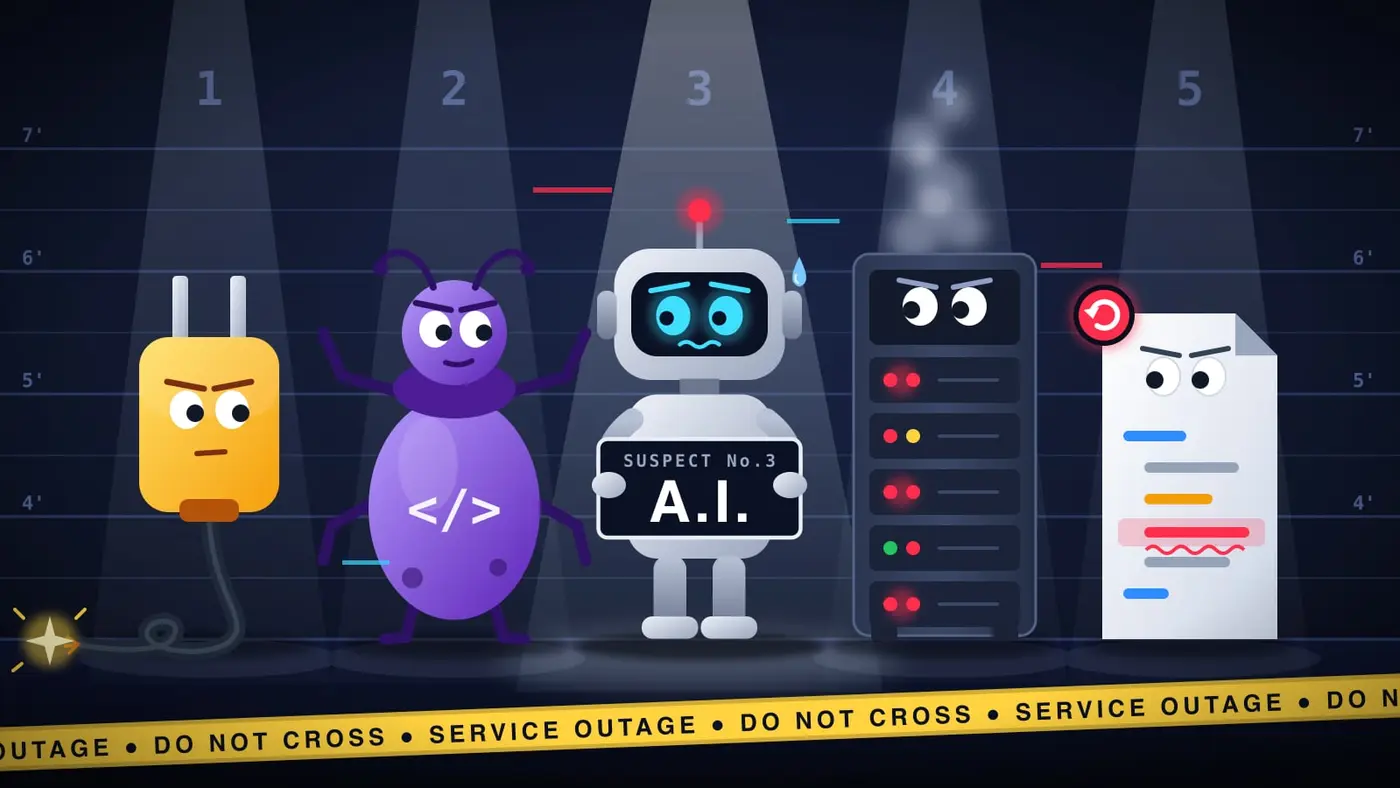
For four working days, it felt like the whole machine was coming apart.
On Thursday 12 November, Outlook went dark for millions of people. On Friday the FAA halted every departing flight in the United States. On Monday, Chase customers ran into errors trying to bank, and United’s departures stalled. On Tuesday, Apple’s iCloud and App Store went down, Marriott guests couldn’t sign in, and CNN reported that the NSA’s classified internal network was down. CNBC summed it up: “four major system problems in four consecutive business days.”
By Monday night, America’s Homeland Security Secretary had a suspect. “I believe that it’s the SI,” Markwayne Mullin told Sean Hannity on Fox News, according to Fortune and Mediaite. Fortune says “SI” stands for “super intelligence”, the administration’s preferred term for AI. Mullin said he was passing on the view of a tech figure who asked not to be named: “these programs aren’t designed to work as fast as SI is.”
The internet had reached the same verdict days earlier. So we did the unglamorous thing. We read every official statement, status page and post-mortem we could find, both for this week’s outages and for every case in the past year where AI really was involved.
The short answer: none of this week’s outages has an official cause that involves AI, and two of the organisations went out of their way to rule it out. The AI theory isn’t pure fantasy either. AI turns up in quieter ways: it is finding software flaws faster than anyone can safely patch them, it is piling load onto infrastructure, and AI tools were involved in incidents at Amazon that the company puts down to human error. Here is the evidence, outage by outage.

Every cause above is quoted or summarised from the organisation’s own statement. Graphic: Recently In AI.
Thursday: Outlook and Microsoft 365
We covered this one in detail. The short version: Exchange Online, the service behind Outlook for businesses, fell over on the evening of 12 November, UK time, and Microsoft said the last affected customers were restored at 06:09 GMT on Saturday.
Microsoft didn’t leave much room for the AI theory. Its statement called it “a technical issue not related to cyber or AI / agents”.
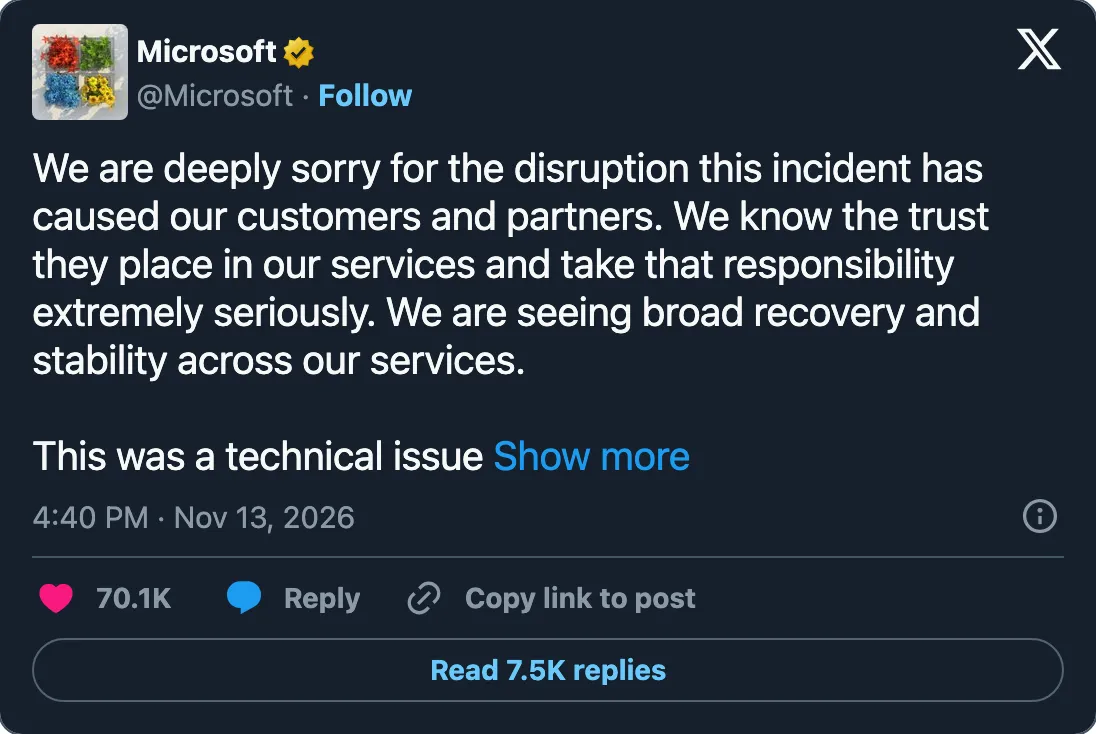
Source: @Microsoft on X.
The preliminary root cause, posted by Microsoft executive Charles Lamanna, describes three things lining up. A defect in a fix that began rolling out in July lay hidden for more than three months. A Teams failover added extra traffic. And about 14% of the gateway’s server capacity was already out of service. “At its lowest, more than 80% of servers were unresponsive,” he wrote. Microsoft has promised a final post-incident review; we hadn’t seen it at the time of writing.
What about the job cuts? Plenty of replies blamed staffing. On 26 October, Microsoft announced what it called “a time-limited, voluntary program” offering some staff in the US, UK, Canada and India money to leave. CNBC reported that about 60,000 people were eligible, roughly a quarter of the workforce, which is where talk of Microsoft cutting a quarter of its workforce came from. That is an offer, though, not a cut. A Microsoft spokesperson told Fortune: “We don’t expect 60,000 people to walk out the door, and we would never want that,” adding that the company expected an “under 5% uptake”. Microsoft has also said AI isn’t driving the buyouts, according to KUOW. Nothing Microsoft has published links the outage to staffing, and we found no credible report that does.
Friday: the FAA stops every plane in America
At about 3:30pm Eastern time on Friday 13 November, the FAA’s systems started failing. Instability spread to 17 of its 22 en route air traffic control centres. The FAA issued a nationwide ground stop, about 3,500 aircraft already in the air landed safely, and traffic resumed at 8:15pm. Operators cancelled about 12,462 flights that day, though the FAA notes that not all of those were caused by the stop.
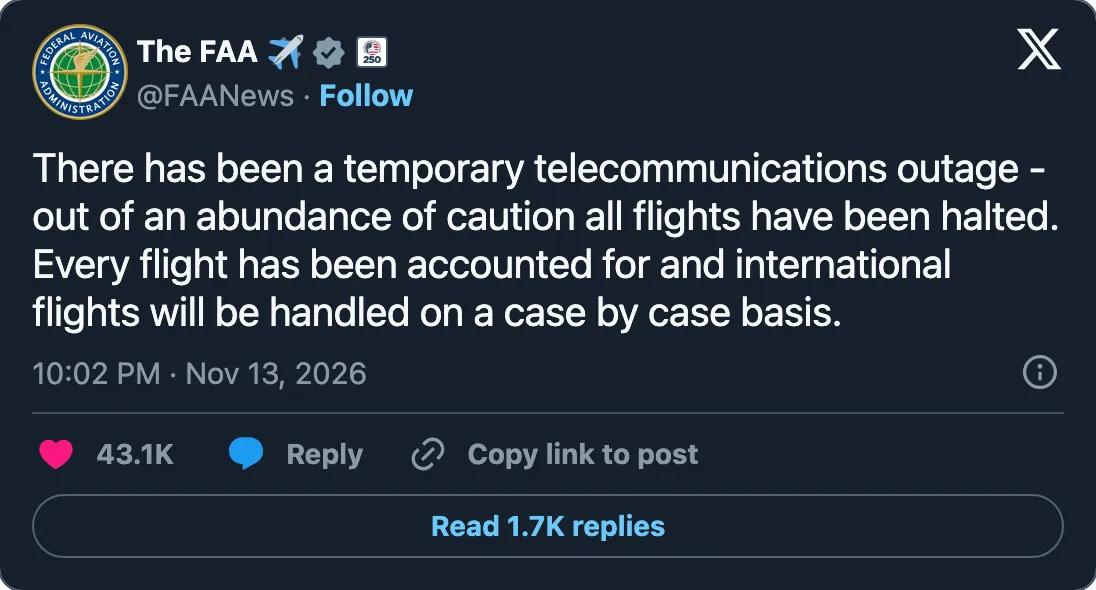
The moment the US stopped flying. Source: @FAANews on X.
This is where the AI theory had its best circumstantial case. Three days earlier, on 10 November, the FAA had expanded a new AI-supported system called SMART to the airspace of all 22 of those centres, AP reported. SMART analyses flight schedules and weather and recommends reroutes. Posts on X claimed it had caused the ground stop. PolitiFact rated that claim “Mostly False”, concluding: “The rollout of the SMART system was unrelated to the outage.”
The FAA’s own Q&A is blunt:
Q: Was this caused by SMART system? A: No. The two systems are not related. SMART is a data aggregator, and it does not feed information into the air traffic control system.
FAA Administrator Bryan Bedford told Aviation Week there was “zero evidence of anything nefarious or AI-related”. After Mullin’s comments, he called the AI speculation “completely unfounded” (Mediaite). Transportation Secretary Sean Duffy described SMART as “predictive analytics” and said of the AI theory: “that is not true.” Air Space Intelligence, the company that built SMART, said the stop was not caused by “the SMART system, any product of ASI or our integration with FAA and ATC” (AP).
So what did happen? According to the FAA:
The FAA’s legacy equipment became unstable when data began flooding the FAA FTI network, at a rate of 1,000 connection attempts every 4 to 5 seconds.
The FAA traced the flood to two places: a radar site in Amarillo, Texas, and a radio site in El Dorado, Arkansas. At El Dorado, L3Harris, the FAA’s network provider, “had been doing work… including deployment of a new router.” The FAA switched off the offending function on the routers involved, then on “more than 60 other Juniper routers” as a precaution, and paused installing them. Juniper’s parent company, HPE, told CNN its “equipment was working as configured”. The FAA puts the instability down to its “legacy TDM system”, not its modernisation work.
The FAA’s Q&A includes one striking admission. Maintenance at major facilities is usually done at night, but this was “a routine replacement at a remote facility”, and “based on what happened Friday, we will reevaluate when we do replacement/maintenance work.” The exact root cause is still under investigation, and the FBI is helping:
FBI Cyber teams are working with the Department of Transportation, the FAA, and L3Harris, providing technical assistance following Friday’s air traffic communications outage. The FBI has not taken possession of any equipment.
Source: @FBICyberBranch on X, 17 November.
Monday: Chase, United, and “the SI”
Chase customers started hitting errors around 11:30am Eastern, CNBC reported. That afternoon the bank gave its explanation.
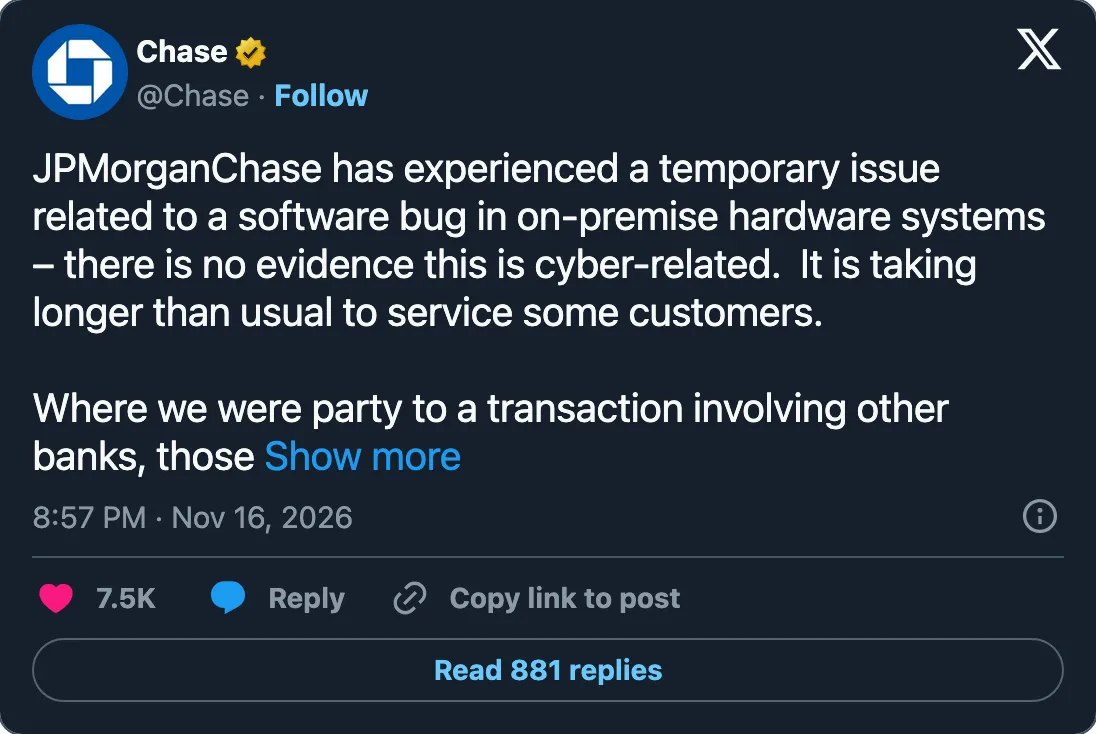
Source: @Chase on X. The rest of the post: “Where we were party to a transaction involving other banks, those banks may have been impacted, but this is not a systemic issue. Customers still have access to their accounts and funds.”
That last line explains why people at other banks saw problems too. Bank of America told CBS its systems were operating normally. Chase said on Tuesday that its systems were back to normal (AP). It hasn’t said more about the bug. AI isn’t mentioned.
Later that day, United Airlines had what it called a “widespread system outage” that delayed departures for about 90 minutes. Flights already in the air weren’t affected. United said there was “no indication that this was a cybersecurity-related issue” and called the cause “a technology issue”. AI isn’t mentioned there either.
That evening, Mullin went on Hannity. On Friday, AP had reported him saying there was “no indication” the ground stop was linked to the new AI system. On Monday he passed on the “SI” theory, while also saying he could tell Americans “with 98% certainty, we’re not seeing a cyber attack” (Fortune). The FAA chief’s “completely unfounded” came the next day.
Tuesday: Marriott, Apple, and the NSA
Marriott. Sign-in on Marriott.com and the Bonvoy app was down for hours. The company said it had “resolved a technical issue” and that “our review found no indication that the disruption was cybersecurity-related.”
Apple. Apple’s own status data shows trouble from 08:15 Pacific time with AppleCare, the App Store, iCloud sign-in, iCloud Mail and iCloud.com, and later with Apple’s business and school tools, with the last incidents marked resolved at 14:00 Pacific. Apple’s statement was one sentence long on the cause: “Many of our systems are back up and running after an internal update caused some outages this morning.” Apple hasn’t said what the update was. A spokesperson said it wasn’t a cyberattack (CBS).
The NSA. CNN, citing six people familiar with the matter, reported that NSANet, the agency’s classified internal network, was down. The NSA said it had “experienced temporary degradation during scheduled routine maintenance” and that “mission-critical capabilities remain fully operational.”
Then the Director of National Intelligence, Jay Clayton, said something more specific on Fox Business:
The patching that has gone on following that has caused some of these systems to not come back up when you patch them as expected… That is what has happened at the NSA today.
“That” is a set of serious flaws in PHP, the programming language behind a large share of the web. According to The Record, “Researchers used artificial intelligence tools to help identify the flaws.” Fortune reported in October that the flaws, nicknamed “php2shell”, were found with the help of OpenAI’s GPT-5.6 Sol and other AI tools, and that the NSA and the FBI urged organisations to patch.
So this is the week’s one real AI connection, and it is two steps removed. AI didn’t break the NSA’s network. A patch did. But the patch was needed because AI helped find the hole. CNBC put the trend plainly: “With the help of artificial intelligence, businesses are patching more software vulnerabilities than ever before.” Every patch is a change, and changes are what break systems.
Where AI really was in the room
For an outage where AI tools were genuinely involved, you have to go back months, and to Amazon.
AWS, December 2025. In February, the Financial Times reported that a 13-hour interruption to an AWS service in mid-December came after engineers let Kiro, Amazon’s AI coding agent, make changes. According to the FT, the tool “opted to ‘delete and recreate the environment’”. Amazon published a rebuttal the same week:
The brief service interruption they reported on was the result of user error—specifically misconfigured access controls—not AI as the story claims.
Amazon said the incident affected one service, AWS Cost Explorer, in one of its 39 regions, and that the misconfigured role was “the same issue that could occur with any developer tool (AI powered or not) or manual action.”
Amazon.com, March 2026. On 5 March, Amazon’s shop and app were down for about six hours. Amazon said the problem “was related to a software code deployment” (CNBC). Days later, the FT reported on an internal briefing note that cited a “trend of incidents” with “high blast radius” and “Gen-AI assisted changes”, and listed “novel GenAI usage for which best practices and safeguards are not yet fully established” among the contributing factors. CNBC reported that the AI bullet was removed before the meeting where the note was discussed. Amazon’s public response:
Only one of the incidents involved AI-assisted tooling, which related to an engineer following inaccurate advice that an AI tool inferred from an outdated internal wiki, and none involved AI-written code.
Amazon also called reports that it had brought in new approval requirements for engineers using AI tools “false”.
That is the pattern whenever AI is near an incident. An AI tool is in the room, and the official cause is the human, the permissions or the process around it. Both things can be true at once.
GitHub, all year. GitHub has been the most candid of the big platforms about AI’s effect on its infrastructure. In April its CTO, Vlad Fedorov, wrote that “since the second half of December 2025, agentic development workflows have accelerated sharply.” He added: “By February 2026, it was clear that we needed to design for a future that requires 30X today’s scale.” On 17 August, GitHub went down for 7 hours and 47 minutes because “traffic reached a new peak, and a critical infrastructure component in our Central US data center failed to scale with it.” Errors in affected services “triggered a client-side retry loop that increased traffic during recovery.” Monthly commits had more than doubled since April, from 1.4 billion to 2.9 billion. GitHub didn’t hide behind the numbers: “That growth explains the pressure on our systems, but it does not excuse these outages.”
A case study of GitHub’s outages published in the journal Future Internet reached a similar conclusion: agentic traffic “exposed and amplified these weaknesses but did not create them.”
Cloudflare, one year ago today. On 18 November 2025, Cloudflare took a large part of the web down with it. Its post-mortem says a database permissions change caused a “feature file” used by its Bot Management machine-learning model to double in size, past a hard limit of 200 features, “resulting in the system panicking.” A machine-learning system was in the failure path, but the model did nothing wrong. The bad file came from ordinary plumbing.
And AI keeps being the victim. On 3 September, ChatGPT, Claude and Grok all had outages on the same day. The Register called it a “True AI-pocalypse”. The causes were thoroughly ordinary: OpenAI cited “a routing error”, Anthropic “an infrastructure issue”, and SpaceX “an outage at our Memphis compute center”. On 29 September, Azure OpenAI in Sweden went down for hours after a planned deployment cleared caches during peak traffic, according to Microsoft’s post-incident review. When a power fault and a generator control problem took out part of Google Cloud’s London region on 20 October, Vertex AI was among 38 products affected.
What the numbers say
The anecdotes point one way, and the best data we have broadly agrees.
- Google’s DORA research surveyed nearly 3,000 professionals in 2024 and found “an estimated 7.2% reduction” in delivery stability “for every 25% increase in AI adoption”. The 2025 report found that AI adoption “now improves software delivery throughput” but “still increases delivery instability”. These are survey-based estimates of failed changes, not counts of outages.
- A Google preprint from August 2026, not yet peer-reviewed, tracked 3.52 million C++ code changes inside the company. AI-generated code broke builds more often (about 1.3 times the rate of human code) but was reverted slightly less often (about 0.9 times). The authors concluded that “the burden of AI-generated code is not found in acute breakages or reverts”.
- Uptime Institute’s 2026 outage analysis found that power caused 45% of respondents’ most recent serious outages in 2025, that networking is the most common cause of IT disruptions, and that “between two-thirds and four-fifths of major IT and data center outages involve some element of human error”. Its take on AI is admirably balanced: it “may in theory reduce these errors — but equally, AI could itself introduce errors.”
The verdict

Each incident is placed by what the organisation itself said, not by our judgement of fault. Graphic: Recently In AI.
This section is our analysis.
Is AI breaking everything? On the evidence, no. Look at what actually broke this week: a defect from July, a router swapped in the middle of a working day, “a software bug in on-premise hardware systems”, “an internal update”, and a patch. These are the oldest causes in the book: change and capacity. Uptime’s data has said so for years, and nobody needed superintelligence to bring down a network that the FAA itself describes as “legacy”.
The “AI did it” crowd isn’t entirely wrong about where things are heading, though. AI is speeding up three things that cause outages:
- Change. More code, shipped faster, in bigger batches. DORA links AI adoption to more failed changes. Amazon’s own briefing note flagged “Gen-AI assisted changes”, even though the company says AI wasn’t the cause.
- Load. GitHub is rebuilding for 30 times its current scale because of AI agents, and its biggest outage of the year was a capacity failure.
- Patching. AI is finding serious bugs faster. Every fix is a change, and this week patching knocked over part of the NSA’s classified network.
None of these makes AI the culprit. AI is the accelerant. It makes every weakness that was already there show up sooner and hit harder.
There is also a reason the AI theory sticks: the vacuum. Microsoft and Cloudflare publish detailed root causes, and both point at ordinary engineering failures. Apple (“an internal update”), Marriott (“a technical issue”) and United (“a technology issue”) have given one-line explanations so far. When companies say that little, people fill the gap with the newest, scariest suspect. If the industry wants people to stop blaming AI, the fix is simple: publish the post-mortem.
Until someone does, here is our verdict. AI isn’t pulling the plug. It’s just making everyone run faster around it.
What we still don’t know
- The FAA’s root cause. The FAA and L3Harris are still investigating, with FBI technical help.
- Apple’s “internal update”. Apple hasn’t said what it was or why it spread across so many services.
- Chase’s bug. We know only that it was “a software bug in on-premise hardware systems”.
- The NSA. It isn’t clear whether NSANet is fully restored.
- Microsoft’s final review. It is still due. If it, or any of the others, changes the picture, we’ll update this article.
Sources
This week’s outages
- FAA: Nationwide Ground Stop: Questions and Answers (15 November 2026)
- The FAA on X: all flights halted (13 November 2026)
- FBI Cyber Branch on X: technical assistance to DOT, FAA and L3Harris (17 November 2026)
- Aviation Week: FAA Says Router Malfunction Led To Ground Stop (14 November 2026)
- AP via ABC News: Questions around FAA’s new SMART AI system, officials say no link to ground stop (16 November 2026)
- Mediaite via AOL: FAA Chief Says Speculation AI Behind Ground Stop Is ‘Completely Unfounded’ (17 November 2026)
- PolitiFact: fact-check on the SMART system and the ground stop (18 November 2026)
- CNN: FAA ground stop and the Juniper router installations (17 November 2026)
- Chase on X: “a software bug in on-premise hardware systems” (16 November 2026)
- CNBC: JPMorgan Chase technical issue (16 November 2026)
- CBS News: Bank online service outages (16 November 2026)
- United on X: technology issue resolved (16 November 2026)
- AP via PBS: United Airlines says it resolved a technology issue that delayed departing flights (16 November 2026)
- Fortune: Mullin’s “SI” remarks (17 November 2026)
- Skift: Marriott Bonvoy sign-ins were down for hours (17 November 2026)
- Apple System Status
- NBC News: Apple outages appear to be resolved after an internal update affected several services (17 November 2026)
- CBS News: Apple outage affecting iCloud, Apple Pay and other services (17 November 2026)
- CNN: Highly classified US national security communications network goes down (17 November 2026)
- Fox Business: Jay Clayton addresses concerns amid widespread tech outages (17 November 2026)
- The Record: Disruptions in NSA’s internal network caused by software patch, DNI says (17 November 2026)
- Fortune: AI tools discovered the PHP vulnerability (21 October 2026)
- CNBC: Widespread outages hit banks, air travel, the NSA and Apple (17 November 2026)
Microsoft
- Microsoft on X: “not related to cyber or AI / agents” (13 November 2026)
- Charles Lamanna on X: preliminary root cause (16 November 2026)
- Official Microsoft Blog: Introducing a Voluntary Exit Offer (26 October 2026)
- CNBC: Microsoft voluntary buyouts (26 October 2026)
- Fortune: Microsoft’s 60,000-person buyout offer (30 October 2026)
- KUOW: Microsoft offers voluntary buyouts to a quarter of its workforce (26 October 2026)
Where AI was involved
- Amazon: Correcting the Financial Times report about AWS, Kiro, and AI (20 February 2026)
- Amazon: Correcting the Financial Times report about recent Amazon.com service incidents and AI (11 March 2026)
- The Register: Amazon denies Kiro agentic AI was behind outage (20 February 2026)
- Financial Times via Ars Technica: After outages, Amazon to make senior engineers sign off on AI-assisted changes (10 March 2026)
- CNBC: Amazon online store suffers outage for some users (5 March 2026)
- CNBC: Amazon plans deep-dive internal meeting to address outages (10 March 2026)
- GitHub: An update on GitHub availability (28 April 2026)
- GitHub: The August 17 outage and the work ahead (20 August 2026)
- Future Internet: Trigger, Not Root Cause: Re-Examining GitHub’s 2024 to 2026 Availability Decline (July 2026)
- Cloudflare: Cloudflare outage on November 18, 2025
- The Register: ChatGPT, Claude and Grok all go down at once (3 September 2026)
- Azure status history: post-incident reviews, including Azure OpenAI in Sweden Central (29 September 2026)
- Google Cloud: europe-west2 incident report (20 October 2026)
Data